MarcDown
Interview Assistant
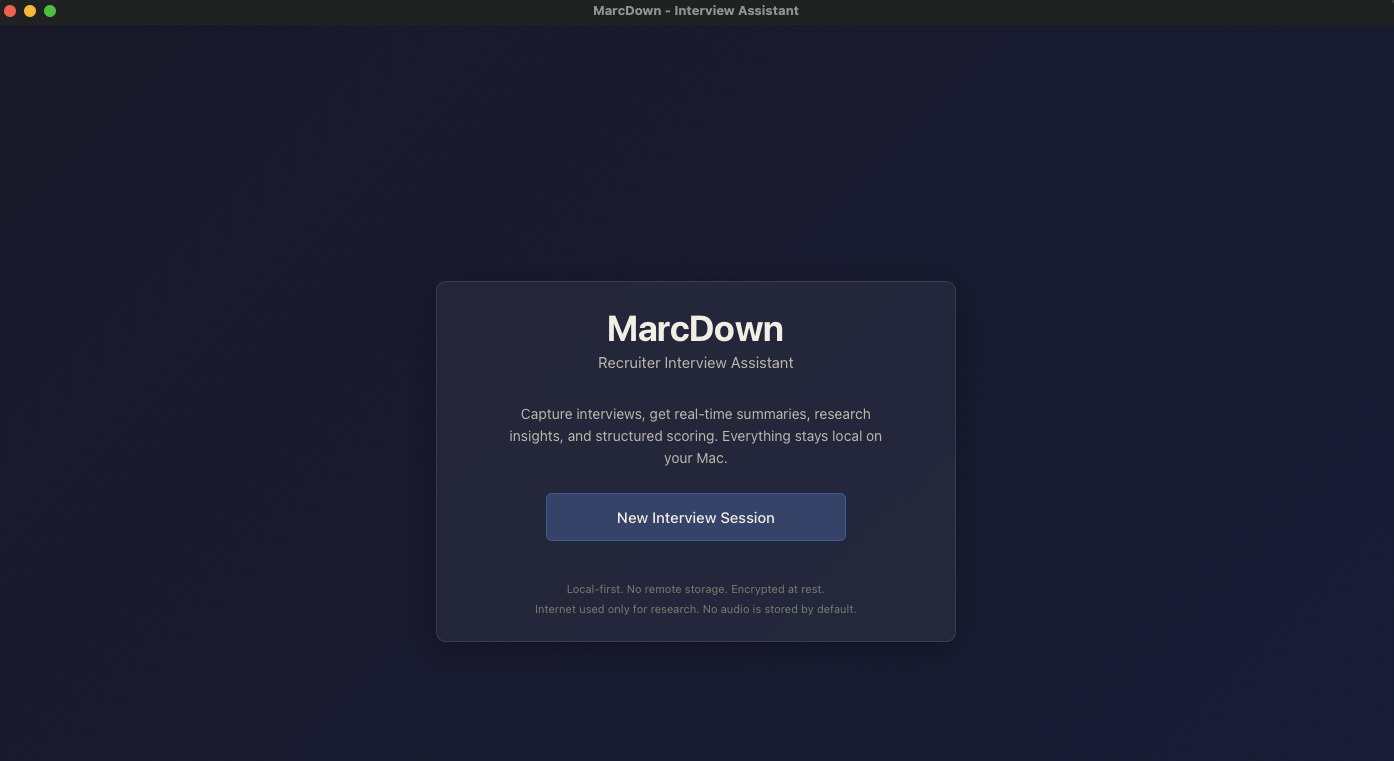
A production-oriented macOS desktop application that sits alongside a recruiter during live interviews — capturing audio, generating real-time summaries, suggesting ranked follow-up questions, and scoring candidates out of 100.
Core features
Real-time transcription
Captures recruiter mic and system audio (works on speaker calls too), producing a single mixed transcript with no raw audio stored by default.
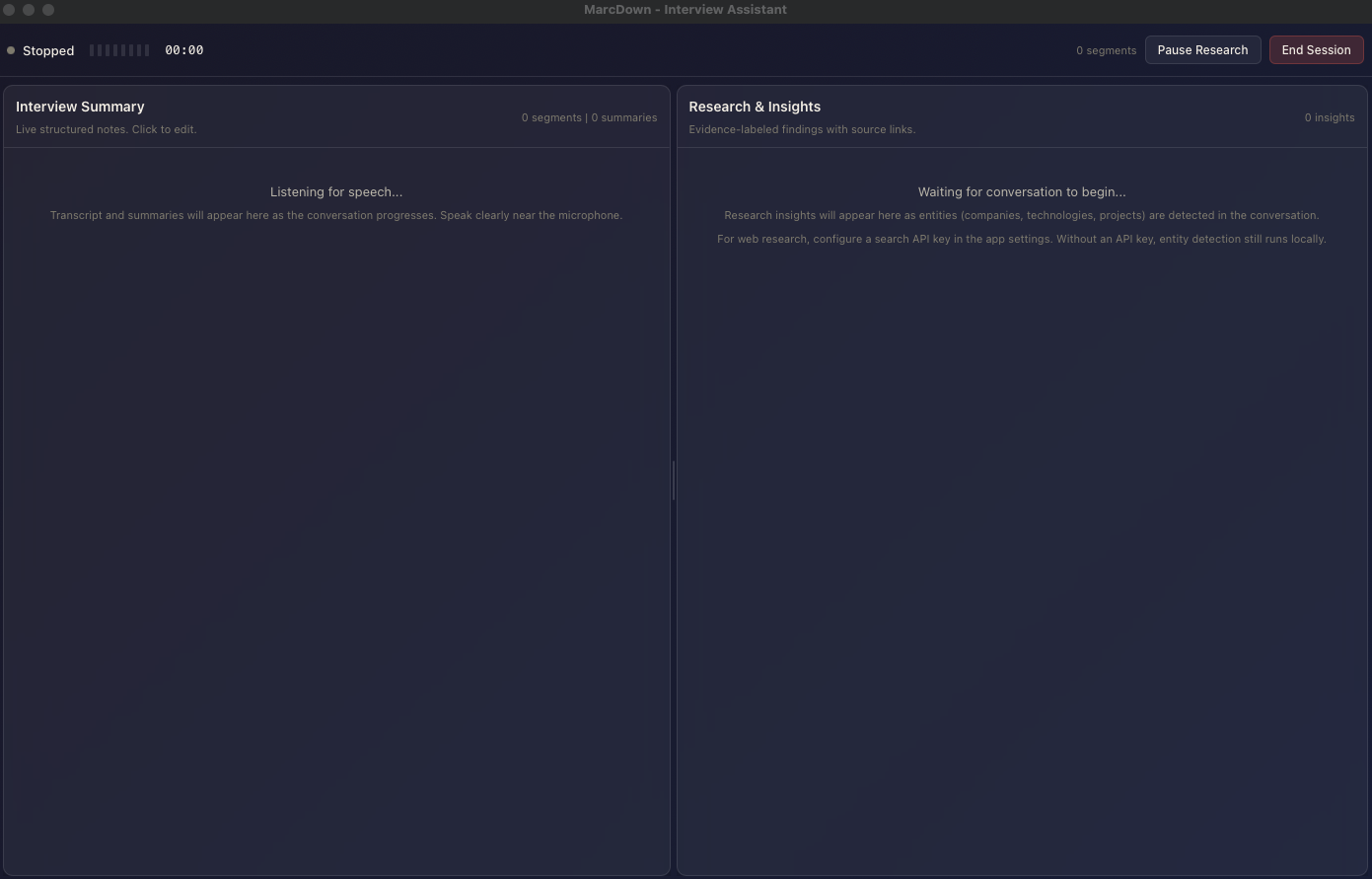
Live structured summary
Left pane continuously updates with Question, Key Answer, and Follow-up Needed sections. Editable by the recruiter mid-session with a one-click copy button.
Research engine
Right pane surfaces condensed web research on entities mentioned (companies, technologies, projects). Each insight is labeled: Transcript Fact, Inference, or External Research.
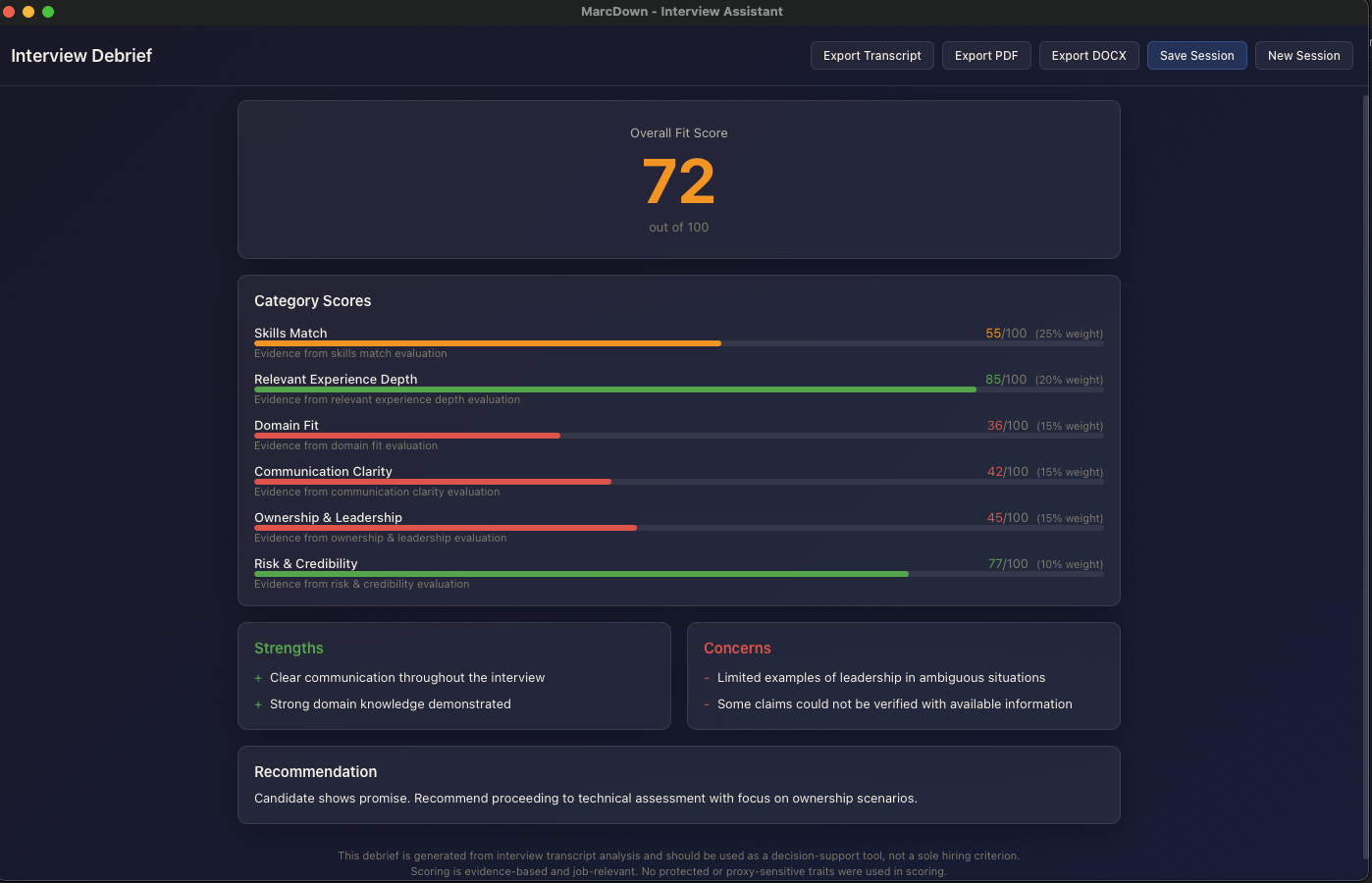
Fit scoring (out of 100)
End-of-session debrief with a weighted overall score and subscores across Skills Match, Experience Depth, Domain Fit, Communication Clarity, Ownership, and Risk/Credibility.
Session flow
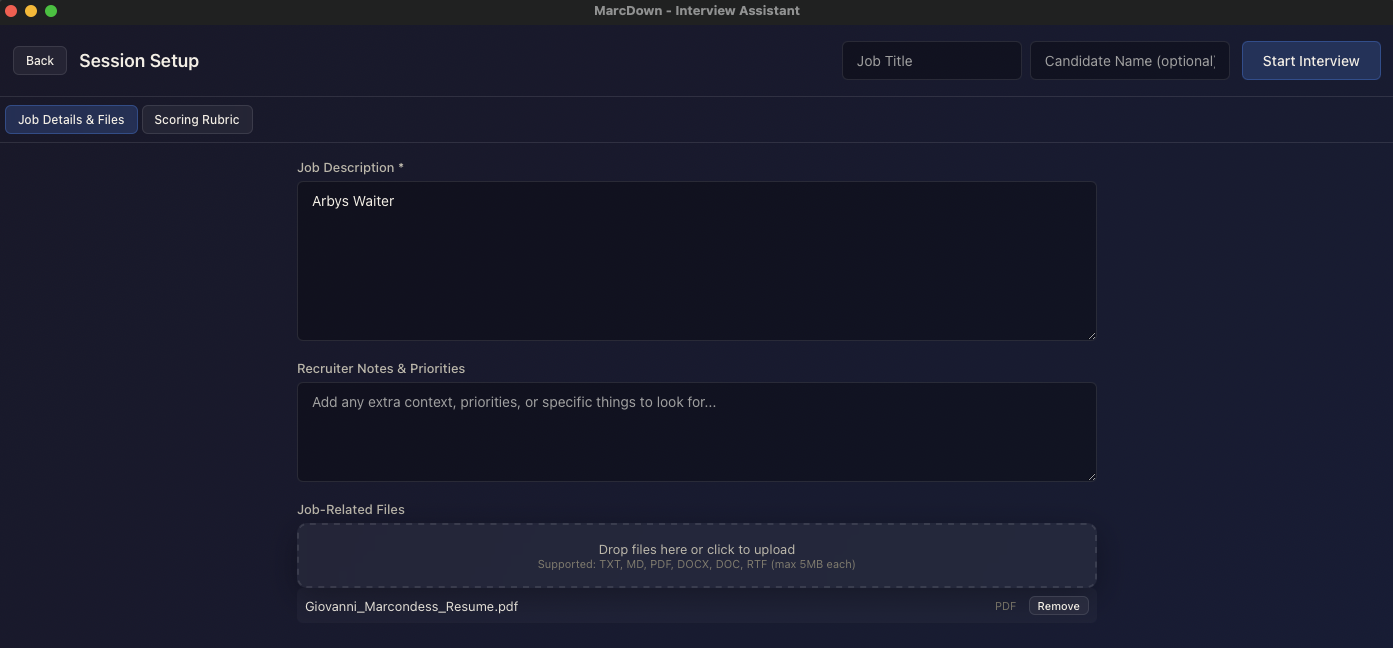
Setup
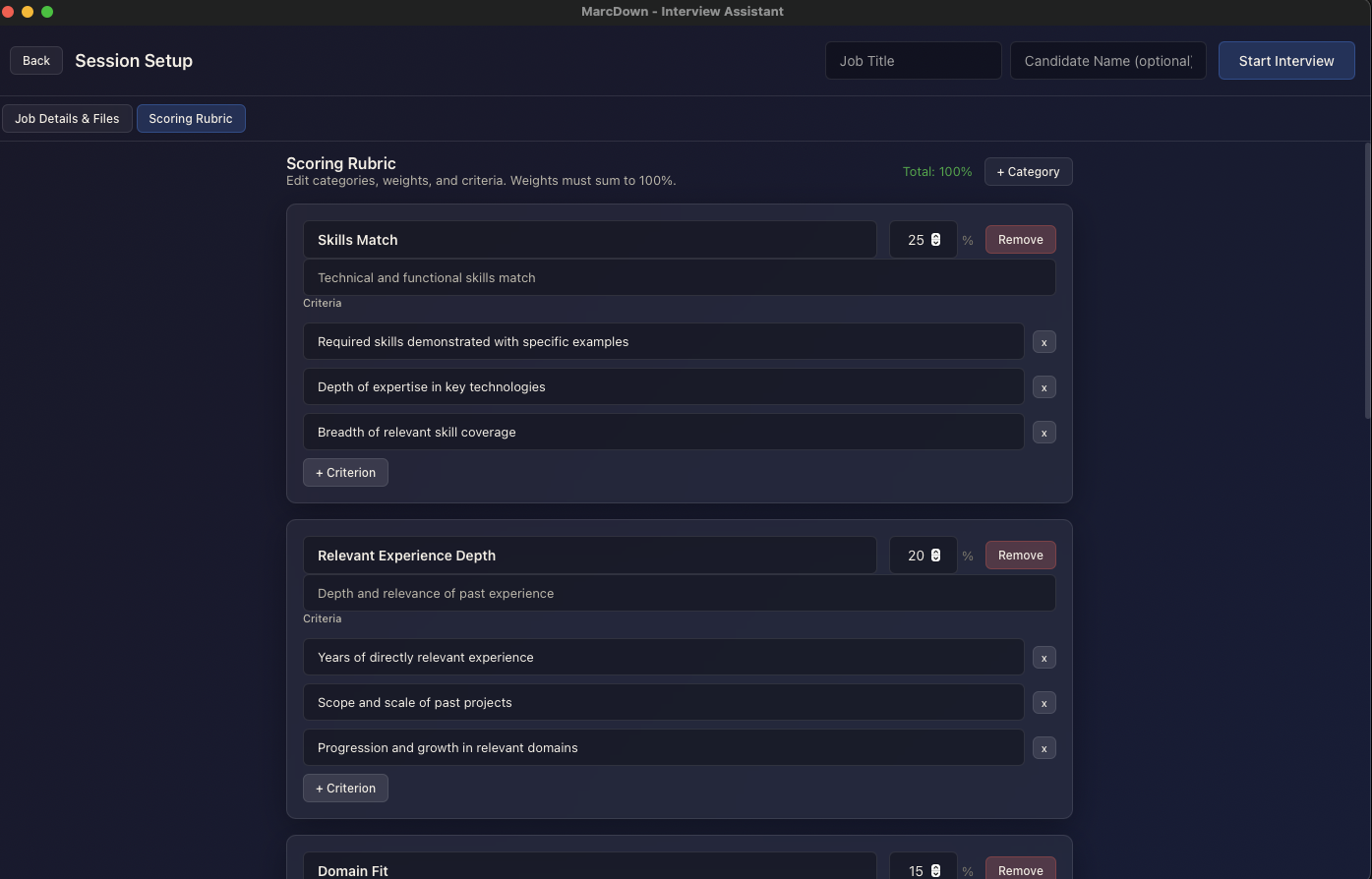
Upload job files, paste job description, add recruiter priorities, review and edit the AI-generated scoring rubric.
Consent check
Compliance warning displayed before any audio capture begins — recruiter accepts legal responsibility.
Live session
Two-pane view: summary left, research insights right. Research can be paused independently from transcription.
Debrief
Score report, strengths & concerns, recommendation, and optional PDF/DOCX export. Data only persists if recruiter clicks Save.
Bias & compliance rules
Protected attributes excluded
Hard-coded rule prevents inference or scoring based on age, ethnicity, religion, disability, health, family status, nationality, or accent-based traits.
Security-first architecture
Secrets in macOS Keychain, encrypted local storage, strict Tauri IPC boundary, no raw audio ever sent to the internet, no hidden telemetry.
Auditable scoring
Every subscore links back to transcript-derived evidence or external research. Low-confidence items are clearly flagged and never presented as facts.
Technology stack
Reflection
"This was definitely one of the most ambitious tasks I have ever done with AI. I wasn't asking for a simple output or a single HTML file. Managing this AI Agent has been very difficult, and the more I stress-test it, the more problems I find. There is no one answer anymore."
— Giovanni Marcondes, BUS 479 Reflection
SDoH Outreach
A full end-to-end data pipeline on Snowflake that identifies and prioritizes individuals with high stress and low wellness for targeted mental-health outreach — using Social Determinants of Health (SDoH) lifestyle indicators and AI-generated notes.
Key stats
Pipeline overview
EDA
Missingness checks, correlation analysis between stress, wellness, exercise, and job satisfaction.
Metrics view
Created WELLNESS_FACTOR view — rescaled scores to 1–7 and computed stress_minus_wellness_7 gap metric.
Semi-structured
Built household JSON table using ARRAY_AGG and LATERAL FLATTEN for household-level risk signals.
AI notes
Used Snowflake AI_COMPLETE to generate triage-based outreach notes with priority labels extracted via regex.
Streamlit app
Interactive dashboard with priority filter, gap/stress sliders, segment explorer, household lens, and CSV export.
What the app does
Executive summary
Live KPIs (people filtered, avg stress, avg wellness, avg gap), gap distribution bar chart, and AI priority distribution — all updating in real time with sidebar filters.
Segment explorer
Group by exercise level, job satisfaction, or ethnicity to identify which demographic segments have the highest average stress-minus-wellness gap.
Household lens
Drills into members_json VARIANT arrays to surface household-level prioritization using semi-structured SQL.
Outreach notes
Full-text search across AI-generated notes. Filter by priority label (HIGH / MEDIUM), matching targeting filters. One-click CSV download for outreach teams.
Technology stack
Business question answered
"How can we identify and prioritize individuals with high stress and low wellness who are most likely to benefit from targeted mental-health outreach using SDoH lifestyle indicators? This enables actionable segmentation for outreach programs (teletherapy/coaching) rather than reporting a single descriptive statistic."
— SDoH Project Report, CIS 355Revamping the
CSU Rec App
A full UI/UX redesign and system requirements specification for the Colorado State University Recreation Center mobile app — transforming a cluttered icon-grid into a clean, student-centered experience with persistent QR login, live facility counts, and streamlined class booking.
Problems with the current app
Barcode display failures — 60% of Rec staff reported barcode not displaying. Users forced to re-generate a new QR code every single visit.
No persistent login — 70% of staff handled sign-in complaints. Users must re-authenticate from scratch every time they open the app.
Cluttered homepage — 20 equally-sized icon tiles on the home screen with no hierarchy. Users struggle to find barcode access and event booking.
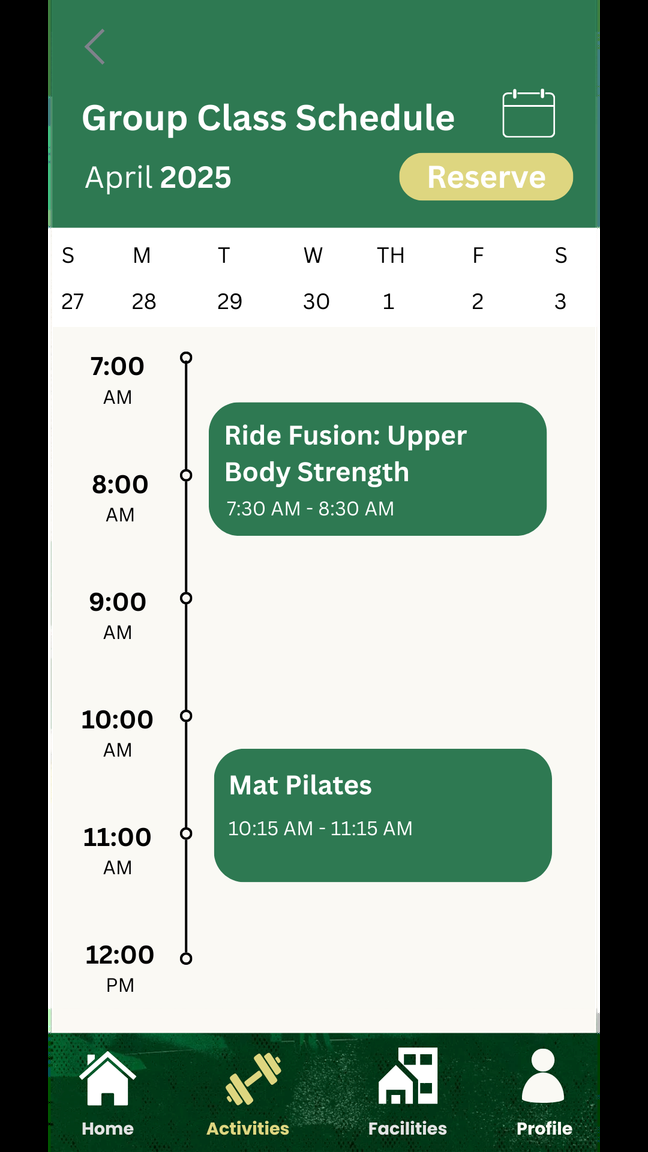
Inefficient booking system — Event sign-up is cumbersome and confusing. Staff receive frequent calls and in-person visits asking about schedules.
Limited push notifications — Users miss class cancellations, waitlist updates, and event openings due to untimely or irrelevant alerts.
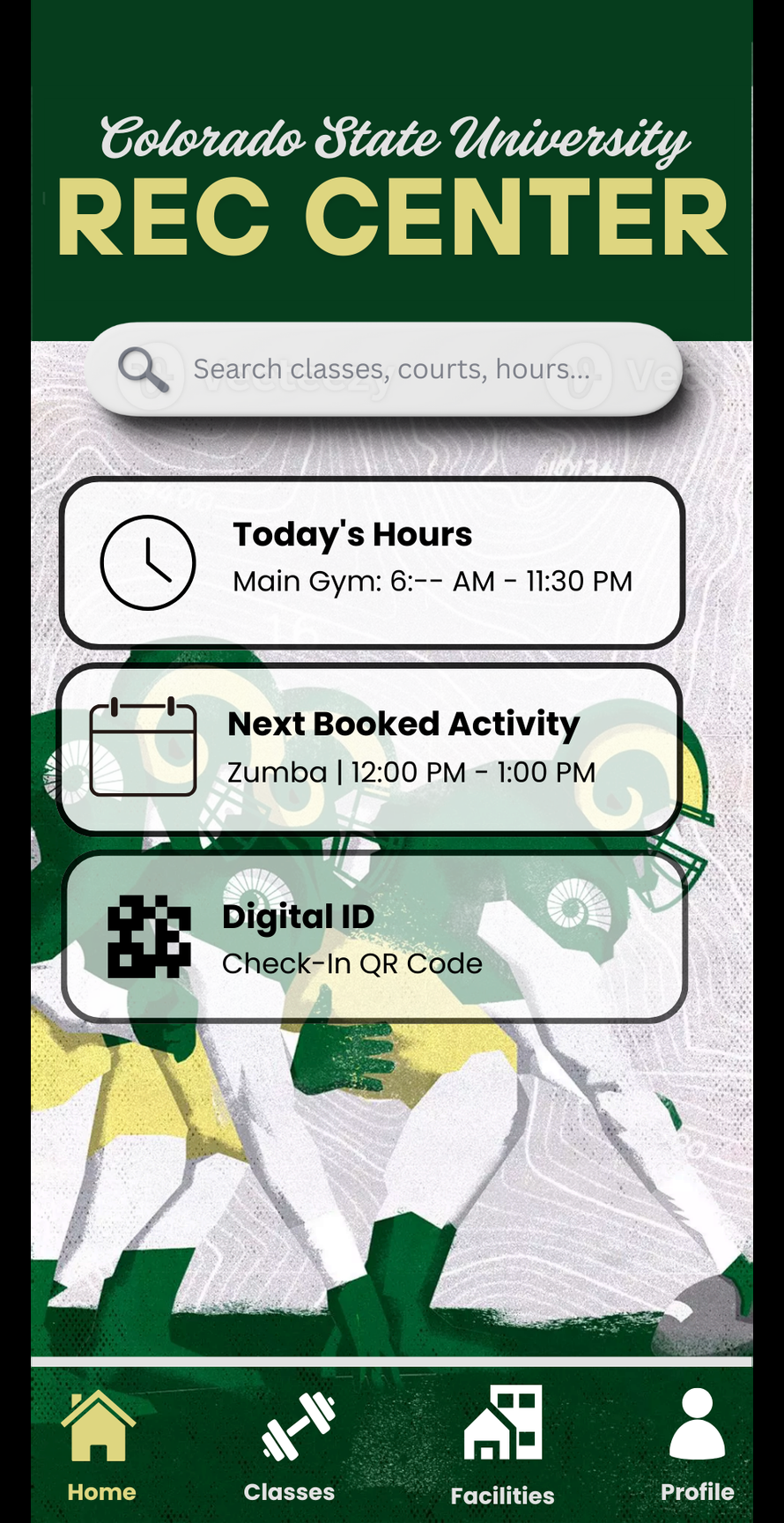
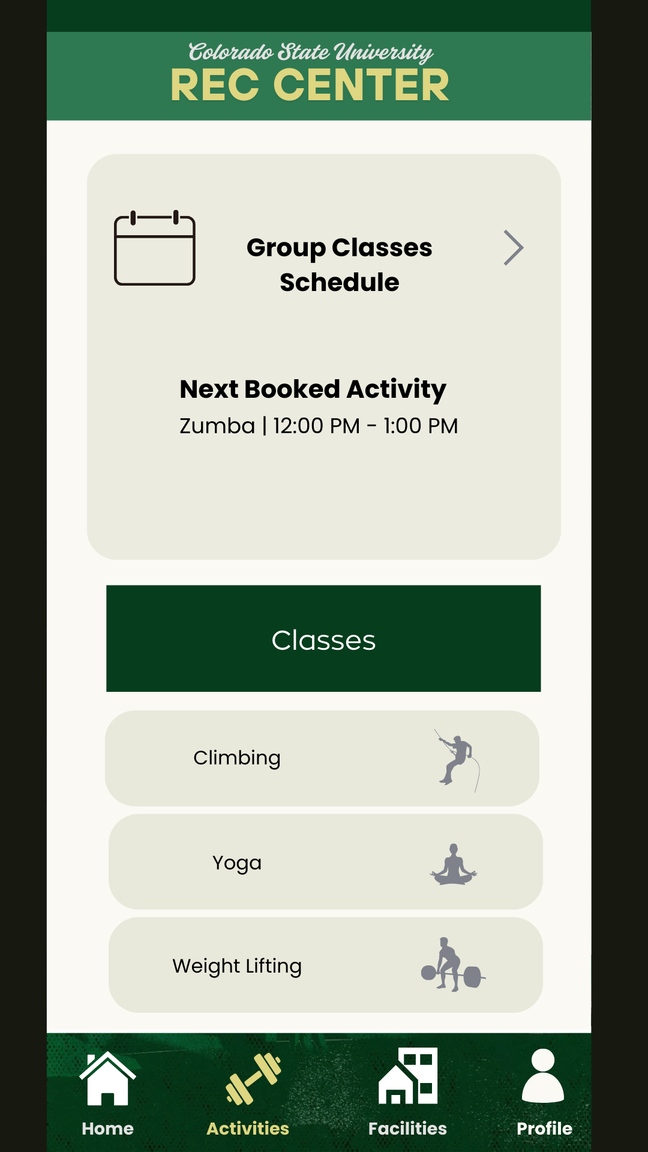
New design — screen mockups
New features delivered
Persistent QR code
One permanent QR code per student that doesn't regenerate on every visit. Resolves the #1 pain point reported by both staff and members.
Simplified navigation
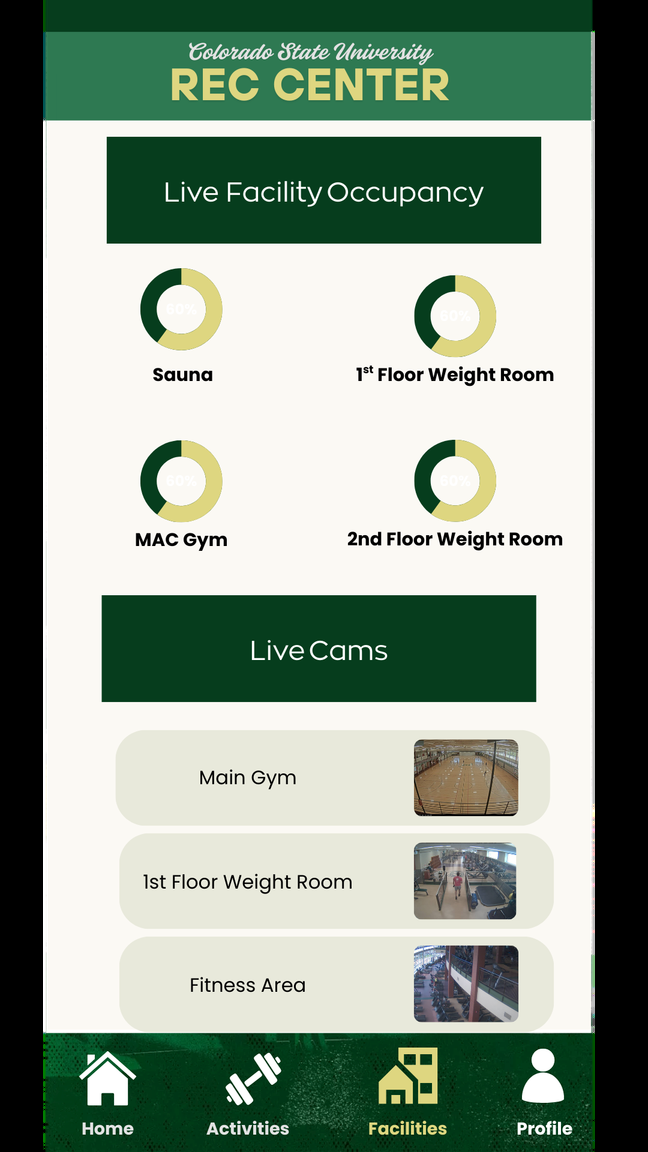
Replaced 20-icon grid with 4 clear tabs: Home, Classes, Facilities, Profile. Search bar provides discoverability without clutter.
Smart notifications
Customizable alerts for class cancellations, waitlist changes, and intramural season opens — without overwhelming users.
Live occupancy
Gym traffic data (already collected and posted to the website) surfaced directly in the app. Facility counts visible side-by-side with live camera feeds.
System requirements (SRS)
Performance
App launch ≤ 5 sec. Login with saved credentials ≤ 5 sec. System handles 1,000 concurrent users. Background sync must not affect battery.
Security
CSU SSO + Duo 2FA integration. Role-based permissions (admin/student/staff). Encrypted stored credentials. Password field masking with reveal toggle.
Design constraints
iOS and Android compatible. React Native shared codebase. Max 80 MB storage footprint. Must support one-handed use. Screen reader accessible.
Reliability
Max 1 crash per 10,000 sessions. 99.9% uptime during rec hours (6 AM – 11:30 PM). Failed syncs auto-retry. Bookings confirmed even on poor connections.
Technology stack
Costco —
The Invisible Opportunity
A full strategic and financial analysis of Costco Wholesale exploring why 76 million loyal paying members largely don't shop Costco online — and what the company should do about it. Includes an interactive website and a live financial dashboard.
The central argument
"Everyone shops at Costco. Nobody shops Costco online. Costco already has everything it needs to win online: 76 million loyal members, the most trusted private label in retail, and an e-commerce platform that — when members find it — delivers strong growth. The missing ingredient isn't technology or product. It's telling people it exists. That is a marketing problem, and it's the most solvable kind."
— Costco Strategic Analysis, core thesisKey headline numbers
The four strategic problems
Awareness gap
Costco spends virtually nothing on digital marketing compared to Walmart or Sam's Club. Most members associate Costco with the warehouse experience — not an e-commerce platform.
Competitive pressure
Walmart's CEO called Sam's Club the company's "innovation engine." Sam's has built scan-and-go checkout, curbside pickup at scale, and a digital-first membership model. Costco risks ceding the digital member.
Structural tension
Costco's economics are built around driving foot traffic. A member who shops online skips impulse items and the food court, and requires costly fulfillment — but resisting digital means losing the next generation.
The signal
E-commerce comp sales grew 16% in FY2024 and 20.7% in Q3. Costco Logistics delivered 4.5M items — up 29%. When members find it, they love it. The bottleneck is awareness, not the platform.
The business model
Sell near cost
Merchandise is priced aggressively — gross margins stay thin at ~11%. The goal is value perception, not merchandise profit.
Membership is the profit
FY2019 fees of $3.35B covered ~72% of operating income. By FY2024 fees reached $4.83B with 76M paid members.
Loyalty funds the flywheel
Low prices → more members → more fee revenue → more buying power → even lower prices. 92.9% US renewal rate sustains the loop.
Digital is the next frontier
Physical warehouses have slowing returns as prime locations fill. The ~7% digital share is the untapped multiplier hiding in 76M loyal members.
Strategic frameworks applied
Porter's Five Forces
Supplier power is low due to Costco's scale. Buyer power is tempered by switching costs. Rivalry from Sam's Club and Amazon is the primary threat — especially digitally.
SWOT analysis
Strengths: member loyalty, Kirkland brand, scale. Weakness: e-commerce underinvestment, warehouse dependency. Opportunity: digital expansion. Threat: Sam's Club innovation pace.
Ansoff matrix
Current position: market penetration (existing products, existing members). Recommended move: market development — bring existing products to members who aren't yet shopping online.
Three-phase recommendation
Tell people it exists
Launch a targeted member email and in-warehouse campaign. Most members don't know Costco.com prices are competitive. Fix that first — it's the highest-ROI move.
Close the price perception gap
Online prices are often higher than in-store. Until that changes (or is clearly explained), digital conversion will stay low. Consider member-exclusive online pricing on select categories.
Invest in digital infrastructure
Expand Costco Logistics, improve site UX, and build a digital-first loyalty layer — following the Sam's Club model before the gap becomes permanent.
Technology & tools
The Invisible Opportunity
A scrollable, editorial-style website presenting the full Costco strategic analysis — with embedded Chart.js charts, an expanding analysis framework section (Porter's Five Forces, SWOT, VRIO, PESTLE), a three-phase recommendation, and a full citations page. Built entirely in HTML/CSS/JS.
What the site covers
Act I — Who is Costco?
Company history timeline, the membership flywheel model explained, and an interactive revenue trajectory chart from FY2017–FY2024.
Act II — The problem
E-commerce comparable growth vs total sales chart, the four strategic problems laid out with insight cards and competitor digital positioning table.
Act III — Evidence & frameworks
Operating margin trend, membership growth chart, plus tabbed framework panels: Porter's, SWOT, VRIO capabilities, and PESTLE analysis.
Act IV — Recommendation
Three-phase action plan with specific tactics per phase, risk/mitigation table, and a bottom-line summary on a dark navy background.
COST · Revenue & Growth Dashboard
An interactive financial overview of Costco Wholesale across six fiscal years — covering total revenue, e-commerce growth, membership economics, operating margins, and competitive digital positioning.
| Metric | FY2019 | FY2021 | FY2022 | FY2023 | FY2024 |
|---|---|---|---|---|---|
| Total Revenue ($B) | $152.7 | $195.9 | $226.9 | $242.3 | $254.5 |
| E-commerce Revenue ($B) | $6.0 | $13.4 | $15.6 | $14.3 | $17.5 |
| Membership Fees ($B) | $3.35 | $3.88 | $4.22 | $4.58 | $4.83 |
| Paid Members (M) | 53.9 | 61.7 | 65.8 | 71.0 | 76.0 |
| US/Canada Renewal Rate | 88.4% | 91.6% | 92.3% | 92.6% | 92.9% |
| Operating Margin | 3.10% | 3.36% | 3.28% | 3.42% | 3.58% |
| E-comm Comp Growth | +22% | +44% | +10% | -6% | +16% |
Costco's revenue nearly doubled in five years and membership economics hit record highs — yet e-commerce remains at just ~7% of total sales. When members find Costco online, they come back (16% growth, 92.9% renewal rate). The bottleneck is awareness and digital marketing investment, not product or platform quality.